Two businesses can advertise on Facebook and Instagram with the same budget, use equally strong creative and need very different campaign structures.
An online retailer might need to generate profitable purchases across a large product range. A care provider needs suitable enquiries within specific locations. A B2B company may need to influence several decision-makers before an opportunity reaches its sales pipeline.
Those differences should shape how their advertising is organised.
 Sarah Warren Digital Account Director
The best Meta ads campaign structure gives the platform enough flexibility to optimise while preserving the controls that matter commercially. That means considering objectives, budget, conversion data, customer value and the buying journey together.
Meta’s guidance encourages simpler account structures, automation, creative diversification, better data and results validation. These are useful foundations, but they still require interpretation for each business. Performance marketing on Meta | Meta for Business
What is a Meta ads campaign structure?
Meta advertising has three main levels:
| Level | What it determines | The strategic question |
|---|---|---|
| Campaign | The overarching advertising objective, with budget allocation at this level where selected | What business outcome are we pursuing? |
| Ad set | Delivery settings, including audiences, placements, scheduling and relevant optimisation settings; budgets can also sit here | Which delivery decisions need separate control? |
| Ad | The creative, copy, format and destination people experience | What will persuade the right person to take the next step? |
Meta documents this campaign → ad set → ad hierarchy in its Ads Manager guidance. Budget settings depend on the configuration selected. https://www.facebook.com/business/m/ads-manager-guide/creating-ads
Understanding the hierarchy is straightforward. Deciding what deserves its own campaign or ad set requires more judgement.
1. Start with the business outcome, then choose the objective
Meta’s objectives include Awareness, Traffic, Engagement, Leads, App promotion and Sales. They support different intended outcomes, so the objective should follow the job you need advertising to do. https://eventsmanager.facebook.com/business/ads
A business seeking enquiries should not assume that inexpensive website traffic will produce inexpensive qualified leads. Similarly, a campaign designed to build awareness should not be judged solely on immediate purchases.
The objective is only the starting point. The conversion location, performance goal and event used for optimisation also need to reflect what success means.
For a service business, that might involve distinguishing between:
- Someone submitting a form.
- An enquiry meeting your qualification criteria.
- A booked consultation.
- A customer who ultimately buys.
Meta supports CRM integrations and lead quality optimisation for supported setups, helping advertisers use downstream outcomes rather than form volume alone. Availability and suitability depend on the campaign configuration and data integration.
Our strategic view: choose the most commercially meaningful outcome you can measure reliably and support with sufficient data. A valuable event that rarely occurs or is recorded inconsistently may provide a weak basis for optimisation.
Before choosing your objective, ask:
- What action creates business value?
- Can we measure that action accurately?
- How long does it usually take someone to become a customer?
- Are we prioritising volume, quality, revenue or awareness?
- What happens after someone responds?
2. Consolidate where it helps, separate where it matters
Creating a new ad set for every interest, age bracket, creative theme or minor audience variation can spread budget and results too thinly.
Meta’s guidance on fragmentation recommends combining similar ad sets where appropriate, while explicitly recognising that businesses have different goals and requirements.
However, simplification does not mean every product, location and offer belongs together.
… a business promoting two services. One generates frequent, inexpensive enquiries but has a low customer value. The other produces fewer enquiries but contributes significantly more profit.
If both are judged against the same basic lead event, the reporting may look efficient while the commercial balance is wrong.
Separation may therefore be justified by:
- Different objectives or conversion journeys.
- Material differences in margins or customer value.
- Budgets that must be reserved for particular locations or services.
- Different languages, offers or landing pages.
- Seasonal deadlines or capacity constraints.
- A clearly defined experiment.
These differences do not automatically require separate campaigns. Some can be handled at ad set or ad level, through measurement, or through suitable optimisation settings.
A useful decision rule: every additional campaign or ad set should have a clear purpose that outweighs the cost of dividing the budget and data.
3. Match the structure to the budget and expected conversion volume
There is no universally correct number of campaigns or ad sets. A modest budget spread across numerous audience segments may generate plenty of activity but little dependable evidence about which approach works.
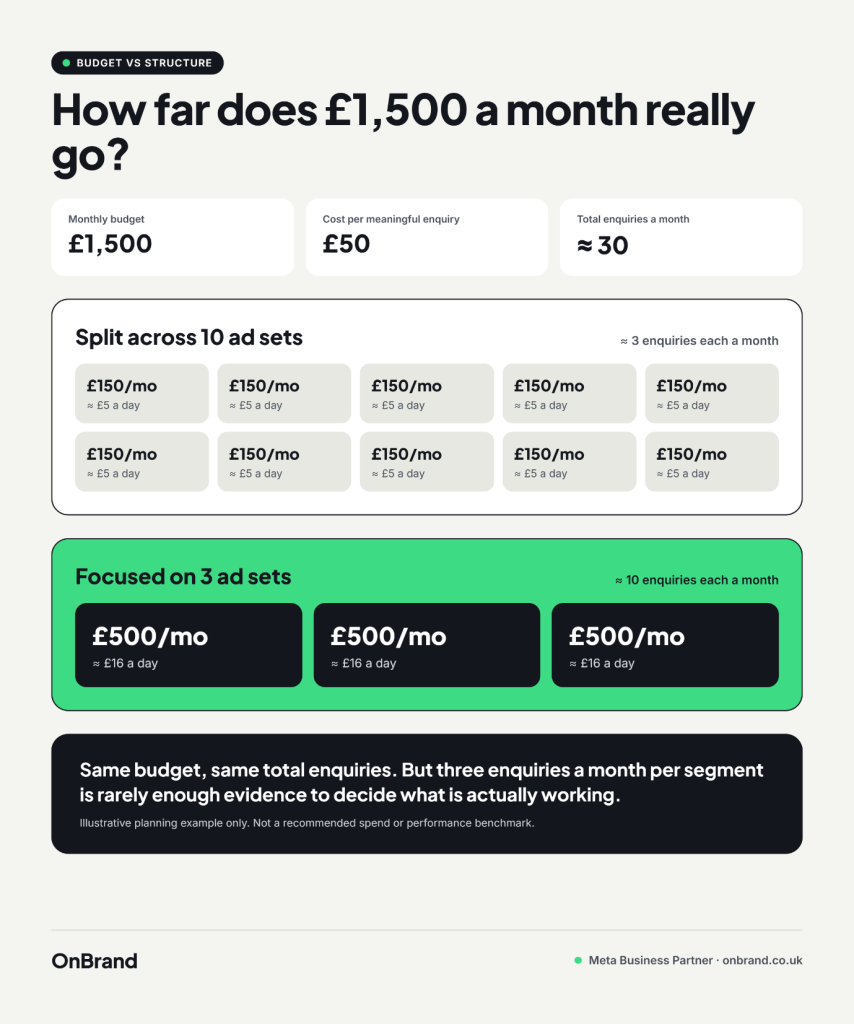
A £1,500 monthly budget spread equally across ten ad sets gives each roughly £5 a day. If a meaningful enquiry typically costs £50, each segment may generate relatively few enquiries over a month. That is a planning example, not a recommended spend or performance benchmark.
The question is whether each part of the structure can gather enough useful evidence to inform decisions.
Meta explains that ad sets enter a learning phase and that significant changes can restart learning. This supports allowing time for evaluation and avoiding unnecessary disruption.
But learning status is not a business KPI. A campaign should ultimately be assessed against customer quality, acquisition economics and its intended role.
For a high-value, low volume business, improving signal quality and assessing outcomes over a suitable period may be more useful than chasing a platform status.
4. Choose budget allocation around commercial priorities
Campaign level budgeting allows ad sets to share a campaign budget. Ad set budgets provide more direct allocation at that level. Meta also offers ad set budget sharing in supported configurations, so advertisers should check the settings rather than assume every ad set budget is fully isolated.
The strategic question is how freely the business can allow money to move.
| Business situation | Budget consideration |
|---|---|
| Several comparable audiences pursuing the same outcome | Flexible allocation may be appropriate. |
| Locations with different occupancy, stock or sales targets | Specific locations may need protected investment. |
| Services with different margins or lead values | The lowest platform cost per result may not represent the best commercial return. |
| A structured experiment | The test needs enough controlled exposure to answer its question. |
| A time-limited event or promotion | Spend needs to reflect the deadline and remaining capacity. |
Equal budgets are not automatically fair tests, and flexible budgets are not automatically aligned with business priorities.
The budget strategy should follow the decision you need to make.
5. Let audience insight shape the strategy without over segmenting
Demographics matter, but they should not automatically dictate separate ad sets.
A care service may be researched by an adult child on behalf of a parent. Children’s activities are often purchased by parents. A B2B service may need to persuade an operational user, a financial decision maker and a business owner.
The person using the service, researching it and paying for it may be different people.
That insight should influence creative, proof points, offers and landing pages. It does not necessarily justify a separate audience for every persona.
Meta’s automated campaign setup also includes controls and manual settings for businesses that need them. The appropriate balance depends on the campaign and its requirements.
Before launching, check:
- Which audience settings are firm restrictions and which are suggestions?
- Can delivery expand beyond the audience you initially selected?
- Does the location setup reflect where you can actually serve customers?
- Are customer exclusions appropriate and sufficiently complete?
- Are demographic assumptions supported by customer data?
- Would different messaging address the need without another ad set?
For younger audiences, do not assume adult targeting options apply. Meta has introduced specific restrictions on advertising to teens, illustrating why age can affect the available approach as well as the creative.
6. Adapt the structure to the sector and buying journey
A template can provide a starting point. It cannot account for every business model.
The examples below are strategic considerations, rather than universal prescriptions.
| Business type | What can influence the structure | What to assess beyond headline results |
|---|---|---|
| Ecommerce | Product margins, stock, purchase frequency, promotions and acquisition versus repeat purchasing | Profitability, returns and new customer contribution |
| Local services | Service radius, appointment availability, branch capacity and response times | Suitable enquiries and booked work |
| Care and other considered services | Trust, family involvement, location and a potentially extended decision process | Qualified enquiries, visits and eventual uptake |
| B2B and professional services | Several stakeholders, niche needs and long sales cycles | Sales acceptance, pipeline and won business |
| Events and children’s activities | Booking deadlines, catchment areas, parent decision-making and remaining places | Completed bookings and capacity filled |
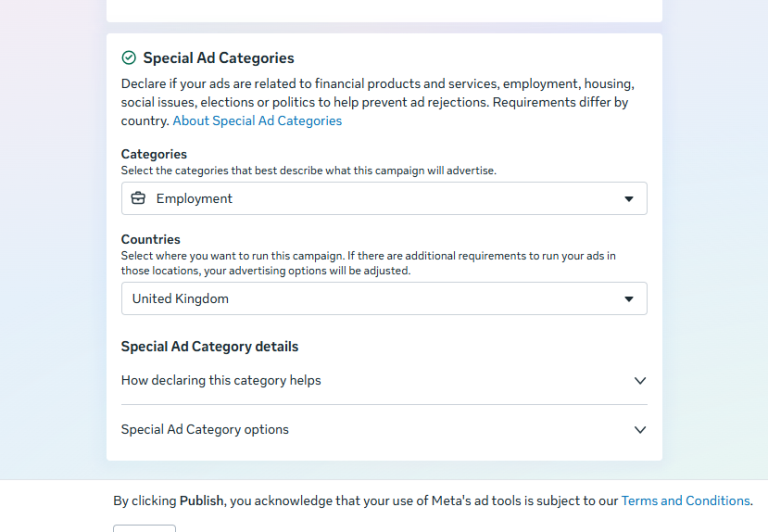
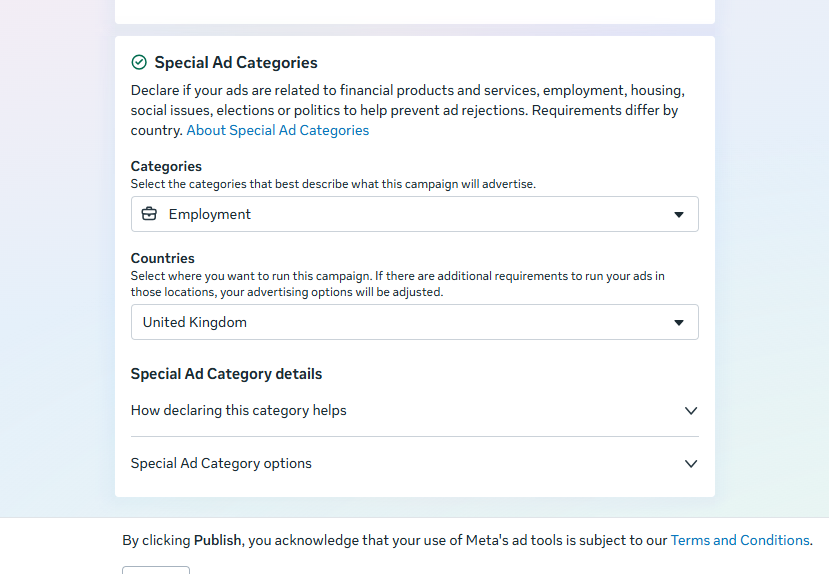
Some sectors also face restrictions that affect the available structure. Meta documents targeting restrictions for housing, employment and credit advertising within its Special Ad Category guidance. The applicable category and country requirements need checking for the particular campaign.
Sector knowledge affects what counts as a good result, which controls are necessary and how quickly performance can reasonably be judged.
7. Give prospecting and retargeting a defined role
It is tempting to build separate campaigns for awareness, consideration and conversion because the marketing funnel has three stages.
That can be useful, but the customer journey does not have to map neatly onto three campaigns.
A smaller advertiser may struggle to sustain several separate audience pools. A larger business with meaningful website traffic, different offers and a longer sales cycle may have stronger reasons to separate them.
Our recommendation is to assess retargeting against a specific purpose:
- Does this audience need a different message or offer?
- Is there enough audience volume to support separate delivery?
- Does the selected setup genuinely restrict delivery to the intended audience?
- How will recent customers or completed enquiries be handled?
- Is repeated exposure helping people decide, or simply increasing frequency?
Retargeting results also need careful interpretation. People who already know the business may have converted anyway.
Meta’s Conversion Lift methodology addresses this distinction by measuring incremental outcomes: results caused by advertising beyond those that would otherwise have happened. Such testing depends on eligibility, scale and suitable study design.
A strong reported return from a warm audience is useful information. It is not, on its own, proof of additional business growth.
8. Build creative variety and meaningful testing into the plan
Campaign structure cannot compensate for an unclear offer or unconvincing advertising.
Meta identifies creative diversification as a core performance principle. That means giving the system different ways to communicate relevance, rather than relying on one execution.
For a considered purchase, useful creative angles might include a demonstration, customer experience, explanation of the process and an answer to a common objection.
These are different reasons to respond. Changing only a headline colour is a much narrower variation.
Placement also matters. Meta recommends Advantage+ placements, but assets still need to work in the environments where they appear.
Our recommendation is to distinguish ongoing creative optimisation from a controlled experiment. Delivery data can identify promising ads, but unequal spend does not provide a clean comparison of every creative.
When a decision warrants a formal test, define the hypothesis, success measure and evaluation period first. Meta’s own training includes A/B testing and conversion lift as methods for evaluating campaign approaches.
9. Design measurement before you launch
The structure should make results easier to interpret.
Agree how campaigns will be named, how links will be tagged, which outcomes will be recorded and how leads will move through the CRM.
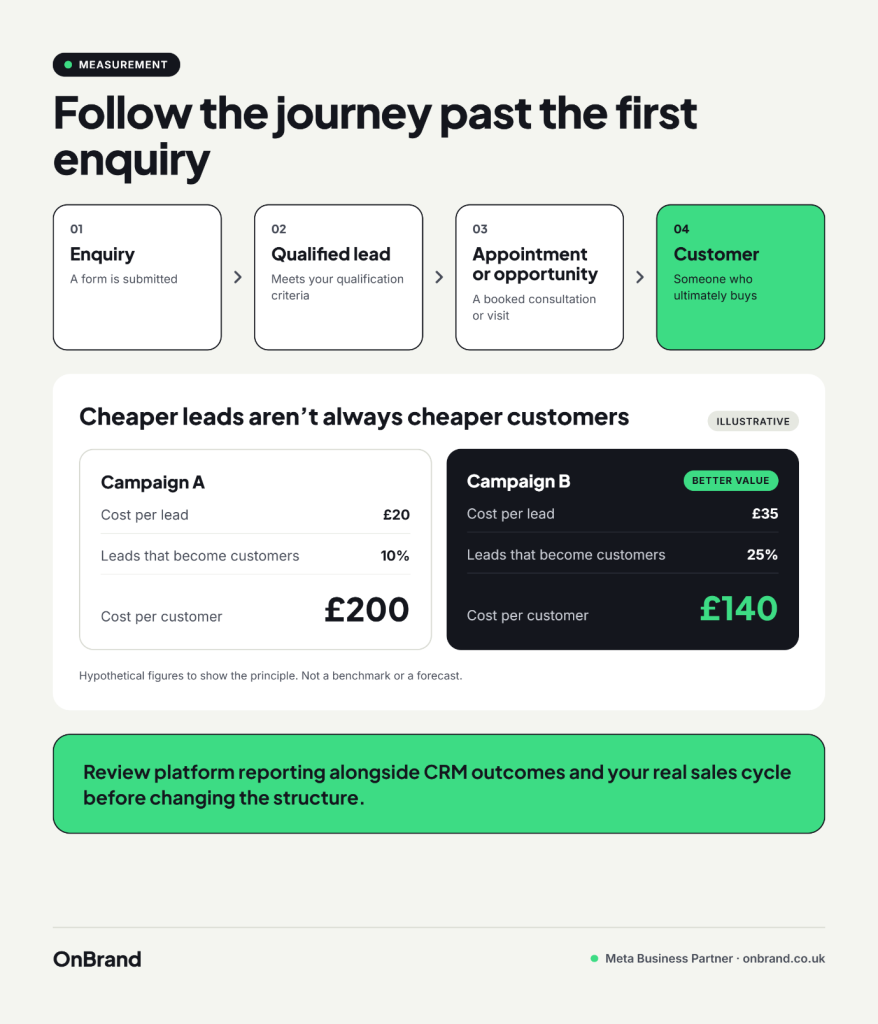
For lead generation, follow the journey beyond the initial enquiry:
Enquiry → qualified lead → appointment or opportunity → customer.
Meta specifically encourages connecting lead management and first party data integrations to improve qualification and follow up.
Our recommendation is to review platform reporting alongside CRM outcomes and the business’s actual sales cycle. Record attribution settings and allow for conversion delays before comparing performance or making structural changes.
This can reveal an important distinction: a campaign with a higher cost per lead may still produce a lower cost per customer.
A practical Meta ads campaign structure checklist
Before approving a new structure, check that:
- Every campaign has a defined commercial objective.
- Every additional ad set has a reason to exist.
- The budget can support the number of segments and tests.
- Optimisation reflects lead quality or customer value where feasible.
- Location, audience and sector restrictions have been checked.
- Budget allocation reflects margins, capacity and business priorities.
- Creative addresses different motivations and objections.
- Retargeting has a specific purpose and sufficient audience volume.
- Measurement connects advertising responses to business outcomes.
- Review periods reflect the sales cycle, with clear reasons for making changes.
The right structure should be explainable in business terms. You should be able to say why each part exists, what it is expected to achieve and how you will judge its contribution.

Meta ads campaign structure FAQs
The best Meta ads campaign structure is the simplest arrangement that supports your objectives, budget and necessary commercial controls. Group comparable activity where it helps delivery, and separate activity when goals, customer value, service areas or measurement needs justify it. There is no single structure that suits every business.
A campaign sets the overarching objective. Ad sets contain delivery settings such as audiences, placements and scheduling. Ads contain the creative and messaging people see. Budgets may sit at campaign or ad set level, depending on the setup.
Use as many as you can justify and adequately fund. Each additional ad set should serve a clear purpose, such as a different delivery requirement or controlled test. Too many similar ad sets can divide budget and results without producing useful insight.
Campaign budgets suit situations where money can move between comparable ad sets. Ad set budgets can help when specific activity needs a defined allocation. Check whether budget sharing is enabled, and choose based on commercial priorities rather than assuming one method is always better.
Sometimes. Separation can help when the audiences need different messages, budgets or measurement. Smaller accounts may not have enough audience volume to support a separate retargeting campaign effectively. Decide based on the audience size, buying journey and purpose of each activity.
Start with Leads when enquiries are the intended outcome, then assess the available conversion location and performance goal. Traffic is designed for visits and should not be treated as a reliable substitute for lead generation simply because clicks look inexpensive. Measure the quality of the resulting enquiries.
Change it when evidence or business requirements justify a change, rather than on a fixed weekly schedule. Allow for conversion delays and the sales cycle, and avoid reacting to a small number of results. Significant edits can restart learning, but tracking faults or unsuitable delivery still warrant prompt attention.
Often, because sales cycles, margins, location requirements and definitions of a valuable conversion differ. A retailer, care provider and B2B consultancy may need different optimisation and measurement approaches. Some campaigns also face Special Ad Category restrictions, which should be assessed before the structure is built.
Editorial note: Meta’s interface, feature availability and policy requirements change. Platform guidance is referenced throughout; sector examples and decision frameworks represent strategic interpretation, not guaranteed outcomes or mandatory account configurations.
OnBrand Meta Ads Team
Sarah Warren
Digital Account Director
Leads your account, strategy and reporting
Read more about Sarah Warren
Prajith Sreekantan
PPC Manager
Runs your campaigns and our Meta partner support
Read more about Prajith Sreekantan
Ciara O’Brien
Destination Marketing Manager
Campaign planning and delivery
Read more about Ciara O’Brien
Charlotte Ball
Marketing & Content Executive
Ad copy and social content
Read more about Charlotte Ball
Holly Davidge
Digital Content Creator
Reels and video-first ad content
Read more about Holly Davidge
Tussunee Roadjanarungtong
Digital Graphic Designer
Static, carousel and campaign creative
Read more about Tussunee RoadjanarungtongRelated Resources
 Blog · Digital
What It Means to be a Meta Business Partner Agency
OnBrand digital marketing agency has Meta Business Partner status. Companies choose us to manage and run their Meta ads. Learn more. Read the article
 Blog · Digital
Meta Conversions API vs Meta Pixel
When it comes to Meta advertising using the Meta Pixel and the Meta Conversions API (CAPI) is crucial for accurate reporting. Learn more. Read the article
 Blog · Digital
Facebook Special Ad Category: rules and campaign planning
Understand Facebook Special Ad Category restrictions, when they apply and how to plan Meta campaigns around your sector, audience and business goals. Read the article
Build your Meta advertising around what growth means to your business
At OnBrand, our approach starts with understanding your objectives, audience and commercial priorities, then bringing campaign planning, creative, tracking and ongoing optimisation together.
Whether you need more suitable enquiries, stronger ecommerce performance or a clearer view of what your advertising contributes, the structure should support that goal.
As an official Meta Business Partner, OnBrand plans, builds and optimises Facebook and Instagram campaigns with an in-house team covering strategy, copy, design and video. Not sure your current structure is pulling its weight? Start with a Meta Audit & Report for £500 + VAT, or explore our Meta ads management services from £950 + VAT a month.
Explore OnBrand’s Meta ads management services to discuss an approach built around your business.